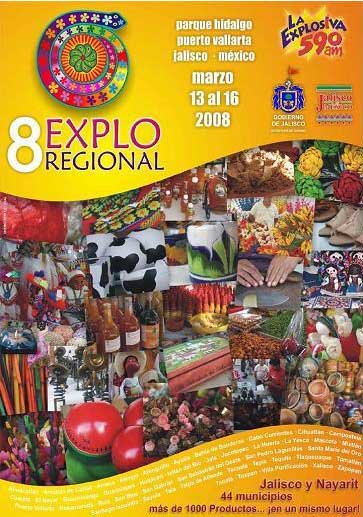
A regional exposition of the products of 44 Jalisco and Nayarit communities.
March 13 to 16 in Park Hidalgo.
Puerto Vallarta Information & Events
A regional exposition of the products of 44 Jalisco and Nayarit communities.
March 13 to 16 in Park Hidalgo.
Festival of Wixaritari (Huichol) Tatei kie
A Show of Wixarika Art Music, Dance, Rituals, Songs and Photography.
March 1-15, 2008 at Plaza Caracol in the Hotel Zona.

Attendance at the festival is free. There is Wixarika art work, traditional music and regional dances and songs and traditional ritual ceremonies with the participation of 50 Wixaritari including artists and traditional musicians. And be sure to test out the peyote fiesta on March 15. It will be a test to see how real these people are.
HOURS: 10am to 9pm daily, with live music from 6-7pm daily.
SPECIAL EVENTS:
Expo Oaxaca
Music, Arts, Foods and Products from Oaxaca are offered and displayed in Park Hidalgo from the 15th of February until the 3rd of March. At this expo, there are several stands with hand-made children’s toys, several hand-made clothing stands, an ice cream stand (flavors worth making the trip for by themselves), a food vendor with inexpensive anjojitos, a couple of stands with traditional Oaxacan food stuffs, including Chapulins (you have to ask since they’re behind the counter), and, of course, a few chachka stands.

VIDEO PRESENTATIONS AND WORKSHOPS:
Sunday February 24
Showing of Bani stui gulal (the history of the Guelaguetza)
Friday February 29
Video workshop “Días de muertos” explanation of the celebrations of the Day of the Dead in Oaxaca.
Saturday March 1
7 pm video workshop “Spirit of Monte alban” explanation of the most important archaeological site in Oaxaca.
There is easy bus access from all sides of town since the park is on both the out-going and incoming bus routes to Centro and there is easy, secure, paid parking under the park.
The colorful GUELAGUETZA ceremony which traditionally takes place on the last two Mondays of the month of July at the Cerro del Fortín, an ampitheater overlooking Oaxaca, will be presented in Puerto Vallarta as part of the Expo Oaxaca, taking place from February 15 to March 3 in Park Hidalgo.
The name Guelaguetza comes from the Zapotec and means the great courtesy. It derives from the custom of the people of Oaxaca helping each other out with harvests or in times of need.
The Guelaguetza, which has a history of more than three thousand years, is presented as offerings to Centeotl, the Goddess of Corn. Catholic missionaries incorporated it into the celebration of the Virgin of El Carmen in the middle of July because of its importance to the people. Since 1932 (Oaxaca’s 400th anniversary) groups from the seven regions of the valley of Oaxaca have presented carefully chosen dances with local characteristics and regional dress at this annual festival.
PERFORMANCE TIMES:
PROGRAM of the GUELAGUETZA:

6th Campeonato Nacional Charro “Vallarta 2008”
LOCATION: Lienzo Charro Miguel “Prieto” Ibarría in Puerto Vallarta in Colonia Mojoneras (not far from the Central Bus Station past the airport).
ADMISSION: 80 pesos for adults (120 pesos on Sunday) and 30 pesos for children.
Link to photos of local Charros
PRIZES:
the First Place Prize (in their saddle-bags, packed to ride off into the sunset) is 200 thousand pesos with 150 thousand for Second Place, 100 thousand for the Third, and 40 and 30 thousand for those who occupy that lonely, but still profitable, land of the 4th and 5th places. In addition there will be fine amounts for individual champions.
CHARREADA SCHEDULE:
On November 12th, 1853, during the presidency of General Mariano Arista, a literary contest was held to select the lyrics of the National Anthem. On February 3rd, 1854, the Official Journal of the Federation published the name of the winner: Francisco González Bocanegra, from San Luis Potosí.
At the same time, another competition was held to set music to the lyrics of the National Anthem. A commission was formed to select the music from 15 different compositions. On August 12th, 1854, the composition God and Freedom, by Jaime Nunó, was declared the winner. Jaime Nunó was born in San Juan de las Abadesas, Gerona, Spain, in September 1825.
The National Anthem of the United Mexican States was heard in public for the first time on September 16th 1854.